Faces of Displacement by Mykola Soroka
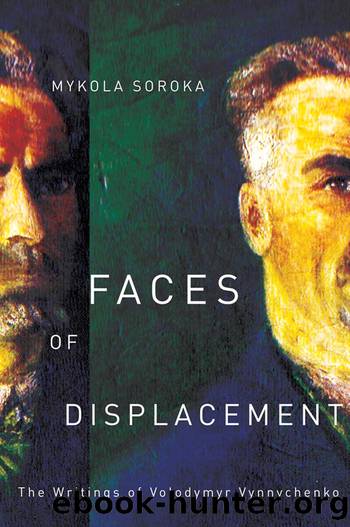
Author:Mykola Soroka
Language: eng
Format: epub
ISBN: 9780773587687
Publisher: MQUP
5
Universalist, 1925â1941
The distant crowing of roosters. Thank God, itâs international; itâs exactly the same as in Canada, Norway, Tokyo, and in the Kherson region in our country
Vynnychenko, Diary, 13 March 1935
The reactions of displaced writers who remain outside their homelands for a considerable period of time generally range between two extreme groups â isolationism and universalism. According to Rubchak, for writers who belong to the first group, writing becomes either âa vehicle for memories and hopes or a totally self-enclosed shellâ (101). Thomas Mann speaks about another extreme which he experienced personally: âExile has become something quite different from what it once was; it is no longer a condition of waiting programmed for an ultimate return, but rather [it] hints of the dissolution of nations and the unification of the worldâ (quoted in Dahlie, 202).
Like Mann, Vynnychenko is a good example of the universalist manner of transformation. From his initial focus on his homeland during his first displacement in 1907â14, his orientation shifted toward a search for a broad international audience coupled with attempts to engage in the current literary discourse of his hostland. While the shift had already occurred during his work on The Solar Machine in Germany, it became especially obvious after his move to France on 6 February 1925. Contributing to his universalist preoccupations in the interwar period were his alienation from the homeland, conflict with the diaspora, and the chauvinistic atmosphere in France. Of course, Vynnychenkoâs universalist program stemmed first and foremost from his devotion to the Marxist ideal of a future egalitarian world, a brotherhood and community of all working people. But his new sense of belonging to the whole planet as a kind of world citizen was largely engendered by his displacement. Now Vynnychenko speaks with increasing frequency in terms of âmy planet,â âmy globe,â and âthe earthâ â phrases that did not occur in his earlier writings.
Arriving in France, Vynnychenko immediately made efforts to engage in the local discourse. Without a doubt he was inspired by the success of his plays, which were still running in other countries, and the prospect of publishing The Solar Machine in France. In his attempts to make new connections he contacted magazines (Nouvelle Revue Française, Le Quotidien, Le Journal, and LâEurope), publishing houses (Flammarion Librairie, Grassi, Librairie du Siècle, and Soir), and the Odeon and Mathurin theatres. Two prominent French actresses, Marthe Régnier and Renée Falconetti, were interested in performing in Vynnychenkoâs play The Lie. Vynnychenko also contacted the famous writers Romain Rolland and Henri Barbusse concerning the publication of his works. He read the works of the French philosophers Jules Payot (La conquête du bonheur), Albert Bayet (Lâidée du bien), Jean-Marie Guyau, and Emmanuel Berl (Mort de la morale bourgeoise); the sociologist Gustave Le Bon (Le psychologie des foules); the psychotherapist and creator of the auto-suggestion method of treatment Ãmile Coué (La maîtrise de soi-même par lâautosuggestion); the German publicist Ludwig Bauer (Morgen wieder Krieg), and the Austrian psychoanalyst Wilhelm Stekel. He also had a great
Download
This site does not store any files on its server. We only index and link to content provided by other sites. Please contact the content providers to delete copyright contents if any and email us, we'll remove relevant links or contents immediately.
| Anthropology | Archaeology |
| Philosophy | Politics & Government |
| Social Sciences | Sociology |
| Women's Studies |
Cecilia; Or, Memoirs of an Heiress — Volume 1 by Fanny Burney(32639)
The Great Music City by Andrea Baker(32611)
Cecilia; Or, Memoirs of an Heiress — Volume 2 by Fanny Burney(32013)
Cecilia; Or, Memoirs of an Heiress — Volume 3 by Fanny Burney(31997)
We're Going to Need More Wine by Gabrielle Union(19111)
All the Missing Girls by Megan Miranda(16337)
Pimp by Iceberg Slim(14687)
For the Love of Europe by Rick Steves(14599)
Bombshells: Glamour Girls of a Lifetime by Sullivan Steve(14142)
Norse Mythology by Gaiman Neil(13460)
Talking to Strangers by Malcolm Gladwell(13448)
Fifty Shades Freed by E L James(13293)
Mindhunter: Inside the FBI's Elite Serial Crime Unit by John E. Douglas & Mark Olshaker(9424)
Crazy Rich Asians by Kevin Kwan(9349)
The Lost Art of Listening by Michael P. Nichols(7554)
Enlightenment Now: The Case for Reason, Science, Humanism, and Progress by Steven Pinker(7356)
The Four Agreements by Don Miguel Ruiz(6841)
Bad Blood by John Carreyrou(6675)
Weapons of Math Destruction by Cathy O'Neil(6372)
